Set the word shape
Type known letters in place and use ? or _ for each unknown position.
For any puzzle that gives you a shape rather than a clue — Wordle, hangman, a cipher, a half-remembered word. Type the letters you know in their exact spots, mark the rest as blanks, and rule letters in or out.
Filling a crossword grid? The crossword solver works the same way but adds clue matching and answer-length filtering.
The pattern length sets the word length. Add fixed letters when a broad pattern returns too many candidates.
Use letters, ?, or _. Spaces and punctuation are ignored.
Type known letters in place and use ? or _ for each unknown position.
The number of characters in the pattern is the exact word length searched.
Add more fixed letters when a pattern like _____ returns too many candidates.
Enter a letter pattern above, or try an example.
Pattern matching is fastest when you know the answer length and a few fixed spots. It does not infer clue meaning; it gives you a clean shortlist that matches the visible shape.
The number of letters, ? symbols, and underscores becomes the exact word length.
Use real letters only where the position is certain. Use blanks everywhere else.
After the list appears, choose candidates that fit the crossword, Wordle, or puzzle clue.
A five-character pattern only returns five-letter words.
More known letters make the candidate list much easier to scan.
Both ? and _ mean one unknown letter in one position.
Very broad patterns such as _____ can return many candidates. Add known letters as soon as you have them.
Spaces and punctuation are removed so copied clue patterns stay usable.
The matcher cleans pasted patterns, converts ? and _ into single-letter wildcards, and compares the complete pattern against WordyLab's word-game data.
Use these checks when the word shape is clear but the answer still needs a tighter shortlist.
The matcher cleans pasted patterns, converts each ? or _ into a single-letter wildcard, then compares the complete pattern against WordyLab's word-game data. It does not infer clue meaning or game rules; it returns transparent pattern matches.
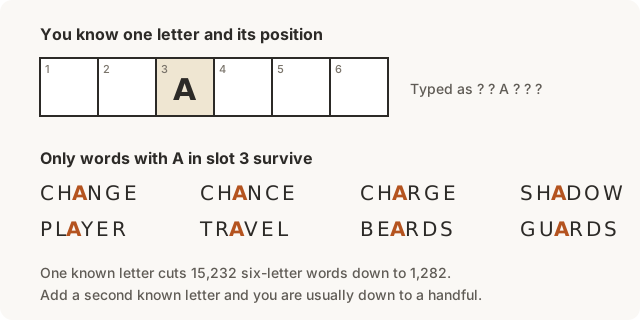
Type the letters you know in their exact positions and use ? or _ for each unknown letter. The pattern length becomes the word length, so _A_E only searches four-letter words.
Yes. The number of characters in your pattern sets the word length, so _____ searches five-letter words.
Both mean any single unknown letter. Use actual letters for fixed positions.
Yes. This page is a pure pattern matcher. The Crossword Solver adds clue context for users solving a crossword grid.
Move to a solver that matches the rule set once the shape alone is not enough.